Volufiline is not filler in a bottle. It is a topical cosmetic ingredient with a plausible lab story, a small supplier-reported study on breast volume, and no controlled facial trial identified in the sources reviewed for this article. At best, a formula may make skin look smoother or subtly plumper through hydration, emollient slip, and light reflection. Patch-test it if you try it, keep your expectations modest, and see a board-certified dermatologist for meaningful volume loss.
What is Volufiline, exactly?
Volufiline™ is a trade name for a cosmetic raw material developed by Sederma and now made by Croda Beauty. Croda lists the INCI as Hydrogenated Polyisobutene (and) Anemarrhenae Asphodeloides (Root) Extract. The plant extract contains sarsasapogenin, a molecule the supplier says can encourage lipid storage and adipocyte differentiation.
That is a supplier description of a cosmetic ingredient, not proof that a face serum can create predictable facial volume. Croda also says Volufiline is an ingredient for professionally developed formulations rather than a finished consumer product. The Ordinary’s viral serum combines its branded Volufiline material with 1% palmitoyl isoleucine and lists hydrogenated polyisobutene first in the full ingredient list.
Thanks for your feedback! Couldn't send feedback. Try again?
Report this addition
How it is supposed to work vs. how filler works
Volufiline’s proposed mechanism is biological: encourage fat cells to mature or store more lipid. Dermal filler is a procedure: a qualified medical professional places a gel, often hyaluronic acid, at a chosen depth and location. The FDA describes HA filler as a material that can combine with water and swell in gel form, creating a smoothing or filling effect.
A topical formula has a harder journey to make a structural change. It must remain stable, pass through the skin barrier, reach the intended tissue, and act evenly enough to look natural. The sources reviewed here do not show that chain happening in the face.
Option
What it actually does and what we know
Volufiline serum
Claim: A fuller-looking appearance from a topical cosmetic ingredient. Where: Surface effects are plausible; growth of deeper facial fat is unproven. Timing: Smoothing may appear quickly, while a true volume effect and its duration are unknown. Evidence: Lab work and a supplier-reported body study; no controlled facial trial found in the reviewed sources.
Hyaluronic acid filler
Action: A qualified clinician injects gel into chosen facial tissue to add structural volume. Timing: The effect is immediate; duration varies by product and person. Evidence: Clinical studies exist, but this is a medical procedure with risks.
Topical hyaluronic acid serum
Action: Helps the upper skin layers hold water and look smoother. Timing: Surface plumping is temporary and depends on continued use. Evidence: Topical HA literature supports hydration and skin-quality benefits.
This table is an editorial comparison, not a treatment recommendation. A dermatologist should review it before publication alongside the under-eye, pregnancy, and product-pairing guidance below.
Thanks for your feedback! Couldn't send feedback. Try again?
Report this addition
The evidence ladder
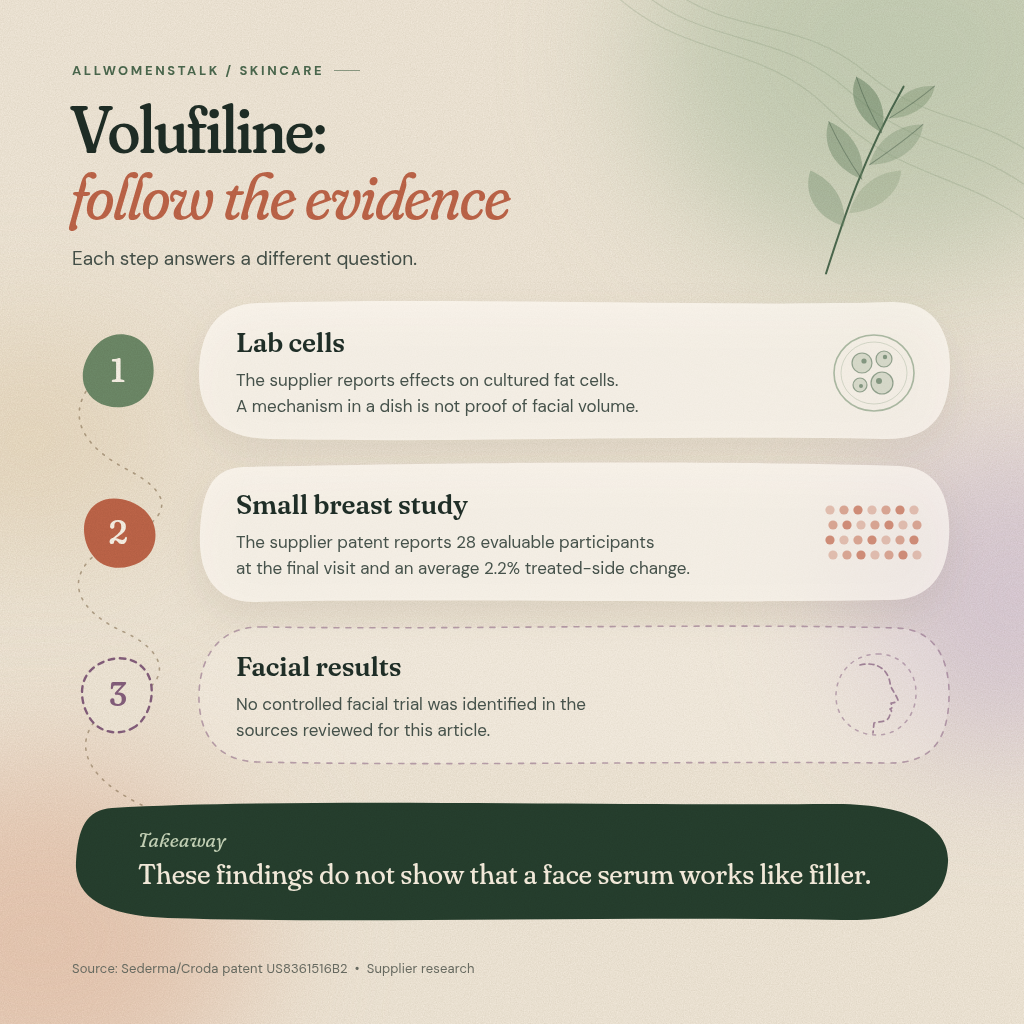
The most useful way to read the Volufiline claims is as an evidence ladder. Each rung answers a narrower question than the one TikTok usually asks.
Open the full-size evidence ladder to save or share it. The breast figure comes from the supplier patent, not a peer-reviewed facial study.
The supplier patent reports a cream containing 5% sarsasapogenin applied twice daily. Thirty people completed the study, and 28 had evaluable measurements at the final visit. The reported average change was about 2.2% on the treated side after the study period. That is a small, supplier-linked breast study with an untreated comparison side. It is not a facial trial, and it does not establish a filler-like result.
Thanks for your feedback! Couldn't send feedback. Try again?
What we know: Every expert source reviewed draws a line between topical skincare and injectable volume. A serum can sit on or move through the upper skin layers; filler is placed at a controlled depth.
Verdict: No. “Filler alternative” is a catchy label, not an evidence-backed description.
Myth 2: “It is proven to grow fat in your face.”
What we know: The ingredient has lab data and a small supplier-reported study on breasts. The reviewed coverage did not identify a controlled, peer-reviewed facial trial.
Verdict: The facial claim is unproven. Do not turn a cell mechanism or body study into a promise about under-eyes, lips, or cheeks.
Myth 3: “Before-and-after photos prove it works.”
What we know: Hydration, emollient slip, reflective texture, lighting, makeup, camera angle, and other treatments can all change how skin looks. Irritation-related swelling is another possible explanation for a short-lived puffy effect.
Verdict: A photo can show that skin looks different; it cannot tell you which ingredient caused the difference.
Myth 4: “92% means the serum is 92% plant active.”
What we know: The Ordinary calls its product “Volufiline 92% + Pal-Isoleucine 1%,” but the full INCI list starts with hydrogenated polyisobutene and includes several other ingredients before the plant extract. The percentage label refers to the branded Volufiline material, not a public percentage of sarsasapogenin in the finished bottle.
Verdict: Read the whole ingredient list. A big number on the front is not the same thing as a high percentage of the plant molecule you are imagining.
Myth 5: “A 100% pure Volufiline oil from a marketplace is better.”
What we know: Experts quoted in Vogue caution that “pure” marketplace products may have uncertain authenticity, dose, stability, and contamination control. Croda says the raw material is intended for expert formulation.
Verdict: If you experiment, use a reputable finished product and keep the packaging and ingredient list. Do not assume a mystery bottle is stronger or safer.
Myth 6: “Results are instant and permanent.”
What we know: An instant change is more plausibly surface hydration, slip, or temporary swelling than newly created facial fat. Expert guidance in the reviewed coverage suggests judging a product over several weeks, while also noting that any benefit may fade after stopping.
Verdict: Expect subtle and temporary at best. “Permanent” is not supported here.
Myth 7: “Natural means gentle for everyone.”
What we know: Botanical extracts and richer emollient textures can still sting, redden, itch, or trigger breakouts. The product maker advises patch testing and stopping if irritation appears.
Verdict: Natural is not an allergy waiver. Sensitive, reactive, inflamed, or acne-prone skin deserves extra caution.
Thanks for your feedback! Couldn't send feedback. Try again?
Report this addition
What might you actually see?
The realistic best case is skin that looks a little smoother, shinier, or more hydrated in the target area. That can be pleasant, but it is different from replacing lost volume. People with mild concerns may enjoy the experiment; people hoping to reverse pronounced hollowing after weight change or aging are more likely to be disappointed.
Pause and get professional guidance if you have active dermatitis, broken skin, significant inflammation, a history of strong reactions, or severe acne. If your concern is under-eye bags rather than hollows, ask a dermatologist or oculoplastic specialist whether added puffiness could make the area look worse; that is a theoretical concern raised in the reviewed coverage, not a proven outcome.
Ask before using it if you are pregnant or breastfeeding. The sources reviewed offer caution, but this article does not treat that caution as a definitive safety finding. A dermatologist or other qualified clinician should make the call for your situation.
If you have meaningful volume loss, especially after rapid weight change, a topical serum will not replace a consultation. A clinician can distinguish hollowing, laxity, edema, and texture changes before suggesting treatment.
Thanks for your feedback! Couldn't send feedback. Try again?
Report this addition
If you still want to try it, do it smart
Patch-test first. The Ordinary advises applying a small amount to clean upper-forearm skin, keeping the area dry, rinsing after 24 hours unless a shorter product direction applies, and not using it if you see redness, burning, itching, blistering, or irritation.
Use it on clean, unbroken skin. Follow the product directions, shake the bottle, and apply after moisturizer to the intended target areas.
Start slowly. A few applications per week lets you notice irritation before making it a daily habit. Ask a dermatologist before combining it with strong acids or retinoids, especially if your skin is reactive.
Photograph consistently. If you want to judge a subtle change, take photos in the same room, light, angle, and expression. Do not compare a bright, freshly moisturized close-up with an older tired selfie.
Stop if your skin objects. Rinse, discontinue, and seek medical advice if the reaction persists or is severe.
Thanks for your feedback! Couldn't send feedback. Try again?
Report this addition
Frequently asked questions
Does Volufiline actually work?
It may make skin look temporarily smoother or subtly plumper, but the reviewed evidence does not show that it creates filler-like facial volume. The strongest human result discussed here is a small supplier-reported study on breast volume.
Is Volufiline a filler alternative?
No. It is a topical cosmetic ingredient, while dermal filler is an injectable medical procedure placed at a controlled depth. They should not be described as interchangeable.
What is Volufiline made of?
Croda lists the raw material as hydrogenated polyisobutene and Anemarrhenae Asphodeloides root extract. The extract contains sarsasapogenin. Finished products add their own supporting ingredients.
Does Volufiline really grow fat cells?
The supplier reports lab findings related to fat-cell biology, and a small body study reported a modest breast-volume change. That does not prove predictable fat growth in the face.
Why do some before-and-after photos look convincing?
Hydration, emollient slip, light, makeup, camera angle, and temporary irritation can all change the appearance of fine lines and hollows. A photo cannot isolate Volufiline’s effect.
Is Volufiline safe?
The available coverage does not provide robust independent long-term facial safety data. Patch-test the finished product, stop if it irritates you, and ask a clinician if you have reactive skin, an eye-area concern, or a pregnancy or breastfeeding question.
Can I use it under my eyes or on my lips?
Some finished products are marketed for under-eye hollows, cheeks, temples, and smile lines, but that marketing is not proof of efficacy. Avoid broken skin, keep it out of the eyes, and ask a dermatologist about bags, significant hollows, or sensitive lips.
Is “92%” or “100% pure” better?
Neither label proves a better result. “92%” refers to the branded ingredient blend in one finished product, while “100% pure” marketplace products may have uncertain identity, dose, and stability.
How long does it take to work, and do results last?
Surface smoothing can look quick. A true facial volume effect has not been established, so there is no reliable timeline or permanence claim. Any cosmetic benefit may fade after you stop.
Is this medical advice?
No. This is cosmetic information. A board-certified dermatologist should review your skin, goals, medical history, pregnancy or breastfeeding questions, and any plan involving the eye area or injectable filler.
Thanks for your feedback! Couldn't send feedback. Try again?
Report this addition
Feedback Junction
Where Thoughts and Opinions Converge
Keep exploring
Search AllWomenStalk for your next read.
Add allwomenstalk.com as a preferred source on Google to see more of our trusted coverage when you search.
Don't Miss the Latest Version
Get the latest stories, save favorites, and share with friends — all in one place.
Choose the look that feels most comfortable for reading.
Your choice is saved on this device only.
Read Allwomenstalk in the app
A calm, image-forward feed of fashion, beauty, wellness and relationship stories. Save your favourites and discover what fits your mood — all on your iPhone.






Feedback Junction
Where Thoughts and Opinions Converge